The 2026 Isle of Man TT Experience
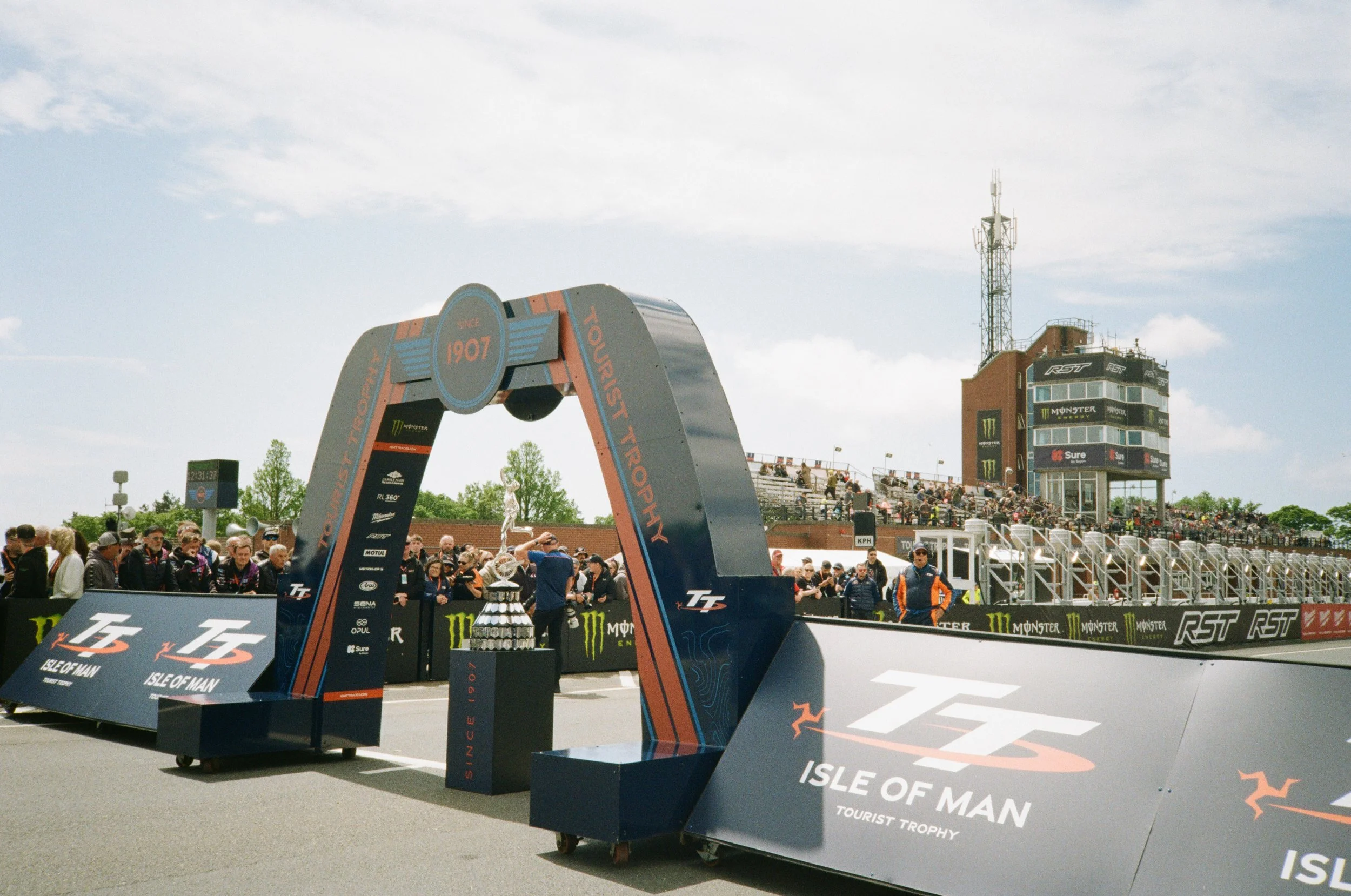
Out of the historic racing events covered so far in SLICKS, the Isle of Man TT is probably the one that needs the smallest introduction. After all, it’s over 115 years old at this point and its reputation extends well beyond the close-knit racing community. Utter those two letters to anybody and they’ll likely say ‘oh that’s where those bikes race on public roads isn’t it?’, and they’d be spot on there.
The Isle of Man TT, the Tourist Trophy (nope, TT does not mean time trial), is run on public roads across the island over a two-week event during May and June. Each day, sections of public roads are closed to form the Snaefell Mountain Course: 37.73 miles, 219 corners and a whistle-stop sampling of the isle’s varying landscapes. Urban high streets, mountain passes, country lane B-roads, with almost all of them being experienced at the top end of your gearbox.
Each year, a pilgrimage of over 40,000 motorcycle fans floods to the Isle (which you can certainly feel when trying to navigate Ronaldsway Airport at the end of the event) to worship the utterly crazy spectacle that is the Isle of Man TT.
The 2026 running of the Tourist Trophy was my first-ever live experience of the event, but by no means am I a complete TT novice. Growing up in South Yorkshire (this is relevant, you’ll soon see), my dad and his side of the family were bike mad. Each year, without question, they’d hop on a ferry or a plane to make their way to a friend’s house that was situated directly on the TT course. El vino would flow, and they’d knock about in the front garden as super bikes clawed for grip up towards Ago’s Leap, mere metres away from their front porch. My dad’s even ridden the course with some gusto, since they make the mountain section one-way-only, with no speed restrictions, at the end of each day, giving the general public a taste of what it’s like to be John McGuinness or Michael Dunlop. Somewhere, at the bottom of an old banana box, there’s a VHS of my dad’s footage, who gaffer taped a camcorder to his bike to record his mountain lap. This was pre-GoPro as well, even more impressive if you ask me
Shall we have a little history lesson before I get into the meaty bits?
The TT has been about since 1907, but racing on the Isle of Man actually started three years earlier. In fact, the first race to take place, The Gordon Bennett Eliminating Trial, was actually a car race. Bikes first raced in 1905 on a smaller course than what’s used today, with average speeds of just 30 mph.
Two years later, at an Annual Auto Cycle Club dinner party, a new race was proposed for motorcycles. The 15.85-mile St. John’s Short Course was created, avoiding the mountains of the Isle of Man since bikes were not powerful enough to make the hill climbs. In May 1907, the first TT race was held, with the single-cylinder race won by Charles Collier and the two-cylinder race by Rem Fowler, riding a Peugeot-engined Norton, averaging 36 mph. The short course was used until 1910, by which point the average speed was over 55 mph and the bikes were powerful enough to tackle the mountains.
The 1911 TT, the first running of the Snaefell Mountain Course, had the Senior victory claimed by Oliver Godfrey, averaging 47 mph. It was also the year of the first recorded fatality, which led to the boycotting of the TT in 1912. The racing continued on the Isle of Man until 1914, when the event was cancelled until 1920 due to the First World War.
Until 1927, practice sessions for the TT were held with the public roads open. It wasn’t until the death of Archie Birkin, who collided with a van, that all sessions were run on closed roads. The 1930s is where the TT gained a lot more momentum. The BBC began covering the races and over 150 machines were entered into the event in 1931. The speeds were gaining momentum, too. The same year, the average lap speed exceeded 80 mph for the first time.
The TT took another break due to the Second World War, returning in 1947 and becoming part of the FIM Motorcycle Grand Prix World Championship (now MotoGP) in 1949. Until 1976, the TT was part of the Grand Prix calendar, with world champions such as Giacomo Agostini taking on the Mountain Course en route to glory. In fact, after 1972 and 10 TT wins, Agostini pledged to never race again on the Isle of Man, claiming it’s far too dangerous to be an event riders are forced into entering by being part of an official championship calendar.
Since its removal from the Grand Prix calendar, the TT has been through many iterations. The Isle of Man Department of Tourism took ownership in the late 1980s, turning the two-week event into a festival-style experience with live music, food and experiences, a lot of which remains to this day. A couple more cancellations took place, too, first in 2001 for a foot-and-mouth outbreak and again in 2020-2021 for the COVID-19 pandemic.
Of course, it’s near-impossible to mention the Isle of Man TT and not discuss safety. There’s an entire Wikipedia page dedicated to TT fatalities and an ongoing debate about whether or not the event should be banned. If you’re after my take on this, it’s quite straightforward. The riders know the risks and (at least now) nobody is forced to participate. Is the quantity of fatalities harrowing? Absolutely. Should the TT be cancelled? Absolutely not. I’ll touch on this later.
For now, I’d like to take you along for my first-ever visit to the Isle of Man TT. The ups (of which there are many) and the downs (of which there is one) and everything in between.
Friday 5 June, 4:30 AM. I awaken in the exotic Premier Inn Runger Lane (North) ahead of my 6:40 AM flight to the Isle of Man. We’re in for a long flight here boys, a whopping 39 minutes, so naturally I downloaded 83 albums to listen to onboard. It’s a bit like how you pack four pairs of undies for a one-night stay. You know, in case you shit yourself three times. Can’t be too careful.
I arrive and join the Monster Energy convoy to our hotel, Comis, aptly taken over with energy drink fridges, bike leathers and a whole load of two-wheel enjoyers. We head to the paddock in a minibus and arrive in Ramsey to sample my first taste of the Isle of Man TT. And holy moly. There’s music, there’s food. It’s a honeypot of race fans from all corners of the globe. Rumour has it we were sharing hospitality with Brad Pitt (or Sonny Hayes for the Gen Z readers) and none other than Noel Edmonds was enjoying a sea bass meal at an adjacent table. Which is a sentence I never thought I’d say.
We were invited to the start line to watch the Supersport Race kick off, which concluded with a 1-2-3 finish for Michael Dunlop, Dean Harrison and Peter Hickman. The TT might be over 100 years old, but what I loved was how the race was still started by two blokes: one with a clipboard and stopwatch, the other with a flag. No fancy lights or timing gear like in F1. That’s proper motorsport. I love it.
Later in the day, we headed down Bray Hill for the iconic view up to Ago’s Leap before a drive up to Creg-Ny-Baa to watch the Sportbike and Senior TT races. This is where things took an unwelcome turn. Whether it was the early start, the travel, the noise, the adrenaline, or whatever, I started feeling quite unwell while watching the Seniors. Granted, I was mere metres away from 180 mph missiles, with nothing but a grassy knoll to separate us, so I’d say a normal response would be to feel a little uneasy. Or maybe it was seeing Noel Edmonds chow down on some salty marine fish, we’ll never know.
Regardless, the Senior TT was red-flagged due to an incident with Erno Kostamo, who, thankfully, didn’t sustain any critical injuries. We headed back to the hotel to freshen up and rest before some media duties in the paddock. Shortly after leaving the Creg, I hurried the driver to pull over, as sick was about to exit my face. There was a bit of dry heaving into some shrubbery, but no more. I returned to my car seat, requesting every single window of the car was wound down. Away we went. That is until we reached the promenade, and I had the car pull over once more. This time, it was a residential wall that fell victim to my stomach activities, but once again, vomit and sputum alluded me.
When we finally reached the paddock, delayed by my two oral heave requests, it was as though my body finally gave me the all clear, and, not too dissimilar to champagne on a Grand Prix podium, sick went everywhere. Trust me to choose the busiest possible place to chunder, looking like I can’t handle my drink. Worst part was, I’d had carrots for lunch.
Anyway, shall we get back to some proper journalism?
Once I’d cleared my airways, I necked a box of Tic Tacs and headed to 8TEN Racing’s hospitality to chat with Davey Todd. The Yorkshireman is a three-time TT winner, but sat out the 2026 event due to an injury sustained earlier in the year at a race in Daytona. Here’s our conversation in full:
Lewis: Before we start, I always like to ask how you feel about these kind of scenarios. Being interviewed for the media. I know a lot of athletes aren’t keen. What’s your take on it, do you get fed up of talking about racing?
Davey: No matter where I am, I love talking about motorbikes, of all kinds. All forms of motorsport, too. Extreme sport in particular. I just love it, it’s the life I always wanted. Motorbikes are sick, aren’t they?
L: What started it all off then? You’re not from a racing family are you?
D: No, not from a racing family, but my dad grew up in a similar way. My dad lost his dad when he was young and never had money. The one thing he had was his love for motorbikes. He worked hard to buy bikes for the road, but never raced. For me growing up, I don’t remember watching cartoons, I only remember watching racing on TV. MotoGP, motocross, super cross, off-road was more my thing growing up and that’s what I wanted to do. I raced motocross from six years old. I made the transition to road and circuit racing in 2016.
L: What was it that made you want to switch to road racing?
D: The funny saying is that I injured myself too much in motocross, and I wanted to do something safer. Ha. Which obviously sounds silly when I now race at the TT. But the main thing was that I smashed my legs up in motocross and I had friends who had moved over to sports bikes and done really well. There’s no jumps, less impact on your legs, so it felt like a safer option to not further damage my legs. That evolved into road racing. I tried BSB first of all, but it requires you to have money, which I didn’t have. Funny story, my younger brother ended up being my mechanic, but he was only 12 years old at the time and he got help from my grandad. We didn’t have the best equipment, but I won two races in my first year and it was enough to get the attention of some teams. Thing is, they were inviting me to ride for them and saying ‘all you need is a £100k budget and the bike is yours’. Well, I barely had £100. So that wasn’t possible, not for a lad from the north east of England.
L: Funny you say that, we’re both Yorkshire lads. What is it with the TT and Yorkshire riders? There’s you, there’s Ian Hutchinson, there’s Dean Harrison, there’s Jamie Coward. Is there something in our water supply up int’ north?
D: Think we all have a different mindset to be able to come here and race the TT. It sort of leads on from what I said earlier. I didn’t have a career in sports bikes because I didn’t have the money. That same year, some friends invited me to the TT. I convinced my boss that it was a work trip. I used to sell insurance and I told him I could sell loads of policies while I was over there. He paid for my flights and I slept on the floor of someone’s race truck for two weeks and experienced the TT for the first time. I’d never even thought of road racing. I knew who John McGuinness was, I knew what the TT was, but I thought it was this unobtainable thing that was out of this world. But when I came here for the first time, the second I saw the first bikes come past, I knew it’s what I wanted to do. I thought every racer would have that thought, but most people who see the TT are put off by it, I was the opposite. It was a natural attraction for me. It’s definitely marmite. You’re either 100% into it and want to compete or you’re certain you’ll never do it.
L: When did you first swing a leg over a bike at the TT? Did you prep, did you watch onboards?
D: From first seeing it in 2017, I knew I wanted to race around the TT. I asked some friends to take me for a lap, watched some onboards and began to plan how I could do it. The learning process started from there. I actually borrowed my brother’s PlayStation and bought the TT game. I played it every day, as much as I could, to the point where just before the the 2018 TT, I managed to get a ride for a team in Ireland and begin to get my name out there. Also, just before the 2018 event, my first time competing, I was 2nd place on the world leaderboards on the PlayStation game. I’d also do laps of the course in a car. I must have done over 100 laps in a car, but it can take you over an hour, so it’s not the most relevant when comparing speed. I actually preferred playing the game versus watching onboards, because you had to be engaged, otherwise your rider would crash.
L: Did you know coming here that you’d be declared unfit because of your accident at Daytona? Or did you come here with the intention and hopes of competing?
D: I’m 12 weeks on from my injury, so I planned to be here and competing. It was my goal. I had to have that goal mentally to not get into a dark place. I had the support from some amazing people over the last few weeks to help with my recovery. Recently, they sent the scans over to TT organisers to assess the details of my injury. We got on a Zoom call a week before the TT and they told me that ‘we weren’t close’ to being safely fit to ride. They said, realistically, we were another ten weeks away, so it was crushing. So so disappointing to get that news and I spiralled into a dark place, that I’m still kind of in. I need to get these two weeks of the TT out of the way and focus on getting fully fit again.
L: Tell me about what’s in been like to be here and not be able to ride.
D: It’s been really tough watching everyone else ride and not being able to. I know they made the right decision though. I tried my best to be ready but they made the right call. I’ve kept myself as busy as possible, doing the TV stuff and making sure my sponsors are happy. Doing as much as I can to not give my brain two minutes to get upset about not racing. I’m glad I’ve been able to contribute something to the TT this year.
L: What’s the rest of the year looking like for you?
D: We need to make a plan. For now, the focus is on getting fit, then we’ll make a plan. Until we know when I can next ride, it’s hard to know what’s coming. I don’t want to set another race as a target and not be ready for it, to avoid the negative feelings again. So it’s getting myself to full fitness and then crossing the bridge to see what’s next.
It’s fair to say the Isle of Man TT exceeded all of my preconceptions. It’s the most terrified I’ve ever been watching a sport. No other race gets you closer, literally within an arm’s reach. And no other sport has witnessed my stomach lining spewed across the fan zone. It was a short in-and-out trip, only seeing one day of racing, albeit full of delays and cancellations for the infamous unpredictable weather, but the taste of the TT that I got has stayed on my tongue ever since. Most races I attend leave me with a ‘right, tick that off the list’ mentality, but this place just makes me want even more. I loved it, and I’ll almost certainly be back again and again.