48 hours with Oliver Solberg
For those of you who’ve been around since the beginning of this magazine, you may remember the very first editor’s note, where I narrowed my involvement in motorsport down to three individuals. For the newer readers, firstly hi, welcome. And secondly, allow me to get you up to speed on who helped lay the foundations of this magazine.
To do that, we need to go back to 2003. Granted, some of you probably weren’t even born then, and for that I feel eternally old and I’m slowly coming to terms with the fact that I may be too old to have a stab at F1. Saying that, though, one of the individuals responsible for all of this, in an indirect way, is even more of an unc (as the young folks say) than I am, and that’s Fernando Alonso. Watching him cut about in his Mild Seven Renault with its grooved Michelin tyres and screaming V10 is not something easily forgotten. The fact that he’s still in F1 to this day, a career older than some of his competitors, beggars belief.
The second of the influential trio was a lanky Italian who knew how to throw a bike around a track. Flamboyant, charismatic and instantly recognisable with his bright yellow #46, I’m of course talking about Valentino Rossi, who was dominating his final season with Honda in MotoGP and failed to finish a single race outside of the podium positions.
Finally, a certain Norwegian was redefining the World Rally Championship and capturing the attention of the world, myself included. In his blue and gold 555 Subaru Impreza WRC2003, little did he know a lad in South Yorkshire was discovering what it looks like to push a machine to its limit. This is Mr. Hollywood we’re talking about here, Mr. 110%, Mr. Petter Solberg.
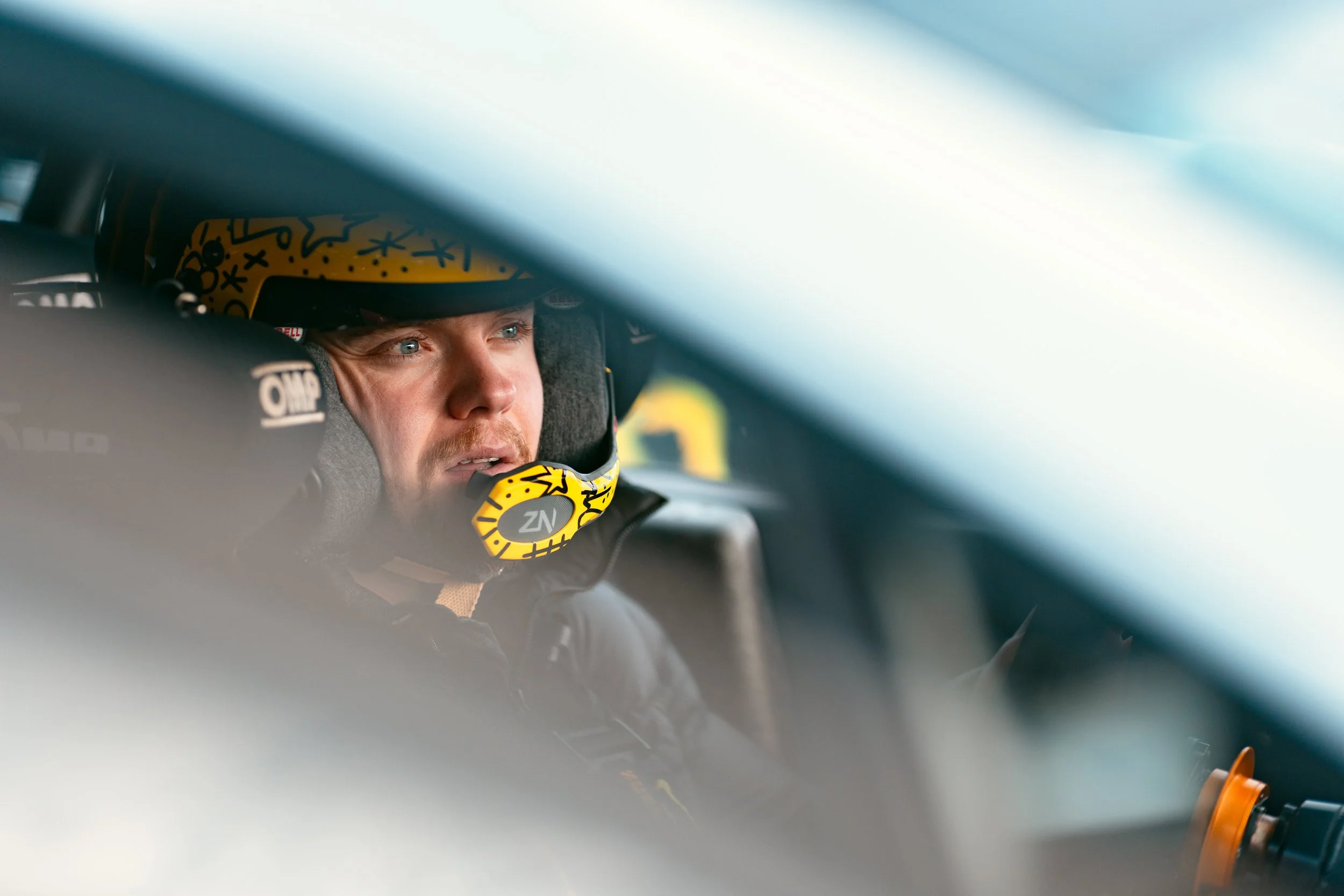
Back to 2026 now. Petter Solberg and his son, Oliver, were hosting a small group of media on a two-day residential in Sweden. I’d caught the attention of Monster Energy at the end of 2025 with Issue 01 of SLICKS, and I was asked if I’d like to come along. Erm, yes please, thank you very much.
What was even more exciting was that Oliver was the hottest name in WRC and had taken rallying by the scruff of the neck, just like his father did in the early noughties. Oh, and would you like to have Oliver as your next SLICKS front cover? Erm, yes please, thank you very much.
So the scene was set and the itinerary was dotted up: I was going to Sweden to hang out with the Solbergs. I couldn’t quite believe it. I don’t have the best luck with international travel (noted in my FAT Ice story earlier in the magazine) and once again I was denied a completely incident-free journey by the travel overlords, who lost my luggage and left me in sub-zero temperatures without a proper coat (or fresh underpants). But even that didn’t stop the experience from being once in a lifetime and completely unforgettable. However, if lightning does strike twice and I’m invited back out to meet the Solbergs, I would like some clean undies and a proper set of thermals next time.
The first day started with an early rise, breakfast and a short transfer to a private, purpose-built track on a frozen lake. As we approached the venue, a GR Yaris overtook us and pulled up outside one of the large buildings in a nearby log cabin park. A road-going rally car driven so swiftly can only be in the hands of one man, and out stepped Oliver Solberg, with his dad assuming the co-driver position. We were invited in, given delicious coffee and cinnamon buns and briefed on what the next couple of days had in store.
“Just have a fucking good time” was a notable moment from Petter’s opening speech and something I was sure I wouldn’t fail to achieve. After all, I’m in Sweden with the Solbergs… have I mentioned that yet?
The frozen lake was unlike anything I’d seen before. It weaved along the tree line, which acted as a natural amphitheatre that surrounded the bed of ice, and a bespoke track had been carved out specially for the Solbergs to practise and play. I was told the ice was over two feet thick, so I needn’t worry about falling through, but I continued to do so for the duration of the day. At the edge of the track was a Monster tent, heated and with plenty of coffee and Monster to hand. It was here I spoke with Oliver and Petter later in the day.
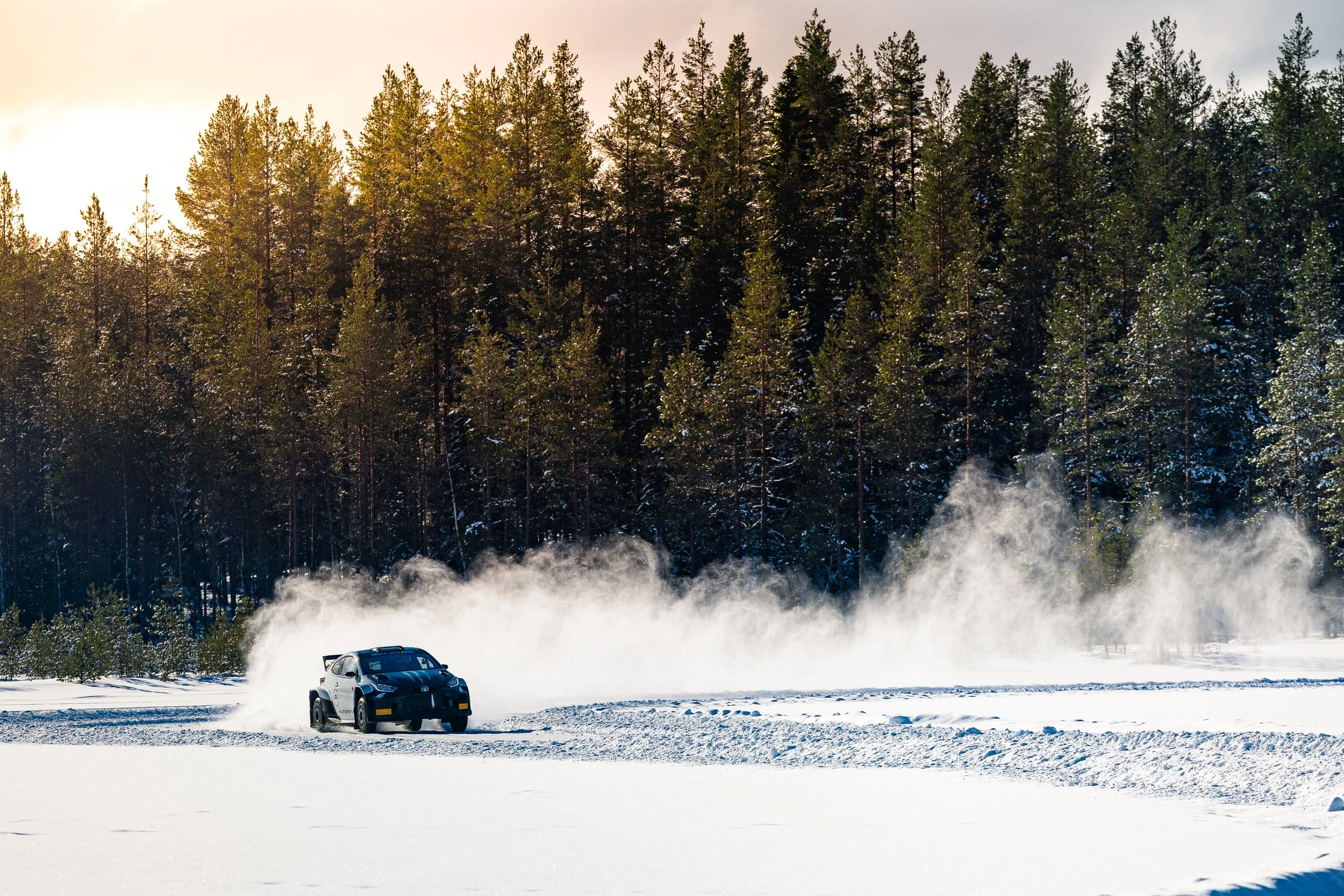
But first, passenger rides. Yep, Oliver and Petter were taking us out in their rally cars. A Rally2 GR Yaris for Oliver and a Polo R for Petter, both thoroughbred machines and multiple rally winners. In fact, Oli’s car took him to WRC2 championship glory in 2025. Long story short, these passenger rides were terrifying and I even had to ask Oli to pull over on our second run together as I was fairly confident that sick was en route up my throat.
Scattered around the lake and encouraged to be put to use were some old Volvo 940s, souped-up and drift-ready. It was here that I met Luke Woodham, Monster athlete, 2025 Danish Drift Champion and four-time Gymkhana Grid World Champion. Sarah, one of my Monster contacts for the trip, collared me into the back seat of one of these old Swedish saloons for a whip around on the ice. I obliged, not knowing that such drifting royalty was at the wheel. What proceeded was much sideways action, a broken handle and a bit more sick attempting to exit an orifice. Some swearing may or may not have happened too.
Once I’d recovered from being chucked around in a Swedish barge, I was invited on a snowmobile tour of the nearby forest, so I popped on some overalls and a helmet and straddled my newest set of… wheels? Skis? Caterpillar tracks? Now, I might have been easily swayed, but there’s nothing quite like being on a snowmobile in the Swedish countryside. I felt like a proper adventurer. I felt like Ben Fogle in that telly thing he did once. Or Richard Hammond in that telly thing he did once.
About 30 minutes into our adventure, the snowmobile tour guide signalled for us to slow down as we exited the forest and approached a vast opening. This was yet another frozen lake, and the guide pointed to it, turned to us and said ‘go play’. He didn’t need to tell me twice. I had a blank canvas of untouched snow in front of me, stretching as far as the eye could see, and it was mine to ‘go play’ with. I tell you what, I felt like Ben Fogle in that telly thing he did once. Or Richard Hammond in that telly thing he did once.
Back at base camp, it was time to do media duties. So here, in my independent motorsport magazine, are my exclusive interviews with Oliver and Petter Solberg (pinch me):
Lewis: Let’s start with what we’re doing today in Sweden.
Oliver: Oh, it's been planned for quite a long time, actually, we’ve been trying to make it happen with Monster. I've had a relationship now with Monster for 9 years, and we have a lot of events at home on the farm, but this is the first time we’ve had a proper media day. You know, on the lake, driving the cars, making sure everyone enjoys the experience.
L: And you say your motorsport's biggest family. Talk to me about that.
O: My mum side is the one which started it all with my grandfather. He was European champion in rallycross in 1980. He used to drive the world championship for Toyota and Lancia in the 70s. Then my grandmother then was co-driving with him. My mum is Norwegian rally champion, my uncle is a rally champion, as is my father. My dad's mother, she is Norwegian autocross champion, and my grandfather is autocross champion. Everybody combined, we are the world's biggest motorsport family. So I don’t think I had much choice other than rally.
L: What about your beginnings, then? How did you come to grow up in Monaco?
O: It wasn’t really my life, you know? I loved the time I was there, of course, but when you’re here [in Sweden] playing with quad bikes, cars, doing whatever you want, then having to go back to Monaco, it felt like I couldn’t do what I loved. I did some go-karting in Monaco, with Mick Schumacher and some of the current Formula 2 drivers, but I was never so quick because I wanted to be driving sideways and sliding about like I could on a quad bike in Sweden. I found karting boring. It was my grandfather who took me into crosskarts. They’re buggies on dirt tracks and I was about seven or eight years old. That’s when I knew it was what I wanted to do and we soon realised we couldn’t live in Monaco if that was my goal. At the same time, Subaru dropped out of WRC and my dad didn’t have a team, so when he started his private team with Citroën back in Sweden, it was kind of perfect timing for me to pursue rally too.
L: When did your professional rally career start?
O: In 2017, when I was 15 years old. My first event was in Latvia. My dad was friends with Harri Rovanperä and his son, Kalle, who went on to be two-time WRC champion, had a special licence which allowed him to do Sprint Rallies at age 15, so we did the same. I didn’t do many, but at least it was the beginning. It taught me about pace notes and the process of a rally. Being only 15, I wasn’t allowed to drive on the road sections between stages, so my co-driver [Veronica Engan] had to be small enough to fit in my seat and we’d swap positions between stages. My dad did all of my pace notes on the recce while I sat in the back of the car, and I learned a lot from that. I didn’t always agree with my dad’s pace notes though, so I even saw the road differently to him at age 15.
L: Tell me a bit more about pace notes and the relationship with your co-driver.
O: Take Saudi Arabia in 2025, for example. That was a brand new rally for everybody, so there was no onboard footage or old pace notes to reference. Complete blank page. It’s a 300 km rally and you only get two recce passes per stage. On the first pass, I say what I see and feel and my co-driver [Elliott Edmondson] writes it down in our code. It could even be a code word like ‘banana’, as long as we both understand what it means. The second time through, Elliott reads it out to me and we work out the finer details of the notes. After the recce, I go through videos we’ve recorded. I normally do this alone, and Elliott finalises the pace notes before I double-check them against the video. When you start the first stage on a Friday morning, you kind of have to trust what you’ve written, and then go flat out.
L: Sim racing is important in circuit racing. Do you use it in rallying or is it less useful?
O: It’s impossible to practise real-life conditions and circumstances in a rally sim. I use the simulator, but more for fun. I never use it to practise. It’s impossible for me. But I live in the forest, so I try to practise in real life whenever I can, but now I’m a factory WRC driver, it’s not so easy as the car is quite unique.
L: Tell me about your Polo years with the R5.
O: The dream years, the best years of my life at that point. First time driving international rallies, first time in a four-wheel drive car, and I won straight away to become the youngest ever European Rally Championship winner. I remember it was a great time. My dad stopped his private team in rallycross and they all came over with me. We had our own little team and had a great journey through ERC and the junior championships. I also won my first-ever WRC2 rally with that group of people. It was an incredible adventure. I think I was as quick in the car then as I am now. I think what I learned most was down to having to do everything ourselves. Only having my dad and me as engineers meant we tested and tried absolutely everything on the car. It meant that we almost always knew what to fix.
L: How did you meet Elliott? It’s interesting that you have a British co-driver, just like your dad did with Phil Mills.
O: That’s kind of why I have a British co-driver, actually. Everything I’ve learned from pace notes has been from my father, and they were all in English because of Phil. I tried Norwegian, I tried Swedish, but English, for me, has the best flow, the best rhythm. Growing up in the paddock speaking English and listening to English news and my father’s onboards, I feel like I understand English pace notes better than Swedish or Norwegian, which is strange. Same with video games, the co-driver spoke in English. Phil Mills actually recommended Elliott when I was stepping up into WRC and looking for a new co-driver. Phil said that he’s the best I’d possibly get, so we call Elliott Phil Mills 2.0 now.
L: Are you and Elliott similar, or does it work best for you that opposites attract?
O: He’s so calm and a perfectionist. We are the complete opposite. I’m very talkative, he’s not. But it works. We get along great and we have the same passion for the sport. Also, I have no fucking idea how he does it. I’ve been in the car with my dad, and it’s okay to sit alongside, but to read the pace notes, get the timing and feeling perfect for different roads and conditions, it’s so impressive.
L: Do you see yourself doing something similar to Kalle Rovanperä, in the sense that he won his titles and then departed rallying for a different race series?
O: No, not at all. I’m only 24 and I’ve just started, really. It’s my first full year as a factory driver. Nothing else appeals to me. When I’m fat and 50, maybe I’ll try NASCAR. But take today for example, we’re here on the lake, driving cars and it’s what I was born to do. I love driving rally cars. I don’t know anything else.
L: Do you enjoy media days and the extra work that comes with being a global athlete?
O: I love it. I can share my passion. I’m very talkative guy and I love showing the reason why I love it and why rally is so cool and crazy and different. Unfortunately, rally is not shown as much anymore, especially compared to my dad’s time.
L: The golden era, arguably.
O: The peak of WRC, for sure. It’s fantastic today too and I love to show that to as many people as possible.
L: Estonia, 2025. What does that mean to you?
O: The goal was never to win. There was no pressure from Toyota to win, either. They took me in and committed to me for the future and believed in me. The goal with Toyota in 2025 wasn’t to do WRC2, the goal was to get one chance in a Rally1 car. And when that opportunity arrived in Estonia, it came very quick. I only knew a week before testing. But I did the best I could and managed to win the whole thing, which is incredible.
L: And then you won Monte Carlo on your full-time debut with Toyota, so that’s 2/2 with them.
O: It’s easy to forget that I’d only done three rallies in that car at that point and I had Neuville and Ogier, two world champions, chasing me down. But I don’t think too much about it, I just love what I do. I try to have fun with and do the best I can.
L: Because you won in Monte Carlo, that meant you opened the road in Sweden. Is road position important in rally?
O: Depends where the rally is. Historically, there aren’t many people who’ve won Sweden after winning Monte Carlo. It all depends on how much ice and gravel there is. You kind of know after winning in Monte Carlo that a win in Sweden is unlikely because of the road position.
L: Do things feel different as a full-time driver in WRC?
O: I think as a young driver, you should want to be full-time. I don’t understand doing part-time seasons. Factories like to commit to drivers for a long time, so a full season is an unbelievable opportunity for a young driver like myself. During my dad’s time, three-year contracts were typical and there were unlimited testing opportunities. As a young driver back then, you’d be the third driver and develop over a three-year project. Now, with half seasons, it’s hard to build that relationship with the team and also with the car.
L: I’ll end with engaged life. How is it? How’s Chloe?
O: It’s the best life I’ve ever had, and I’m not just saying that because Chloe can hear me right now. Ha! I’ve never won more, I’ve never been happier, I’ve never been calmer. Everything’s perfect.
L: Set a date?
O: We’re working on it. I said to Chloe, she can have her beautiful princess wedding as long as I can get some of the colour pink in there. I love pink.
As we ended the interview, I gave Oli and Chloe a disposable camera to take to Safari Rally Kenya, and they kindly sent the developed photos back to us for the magazine.
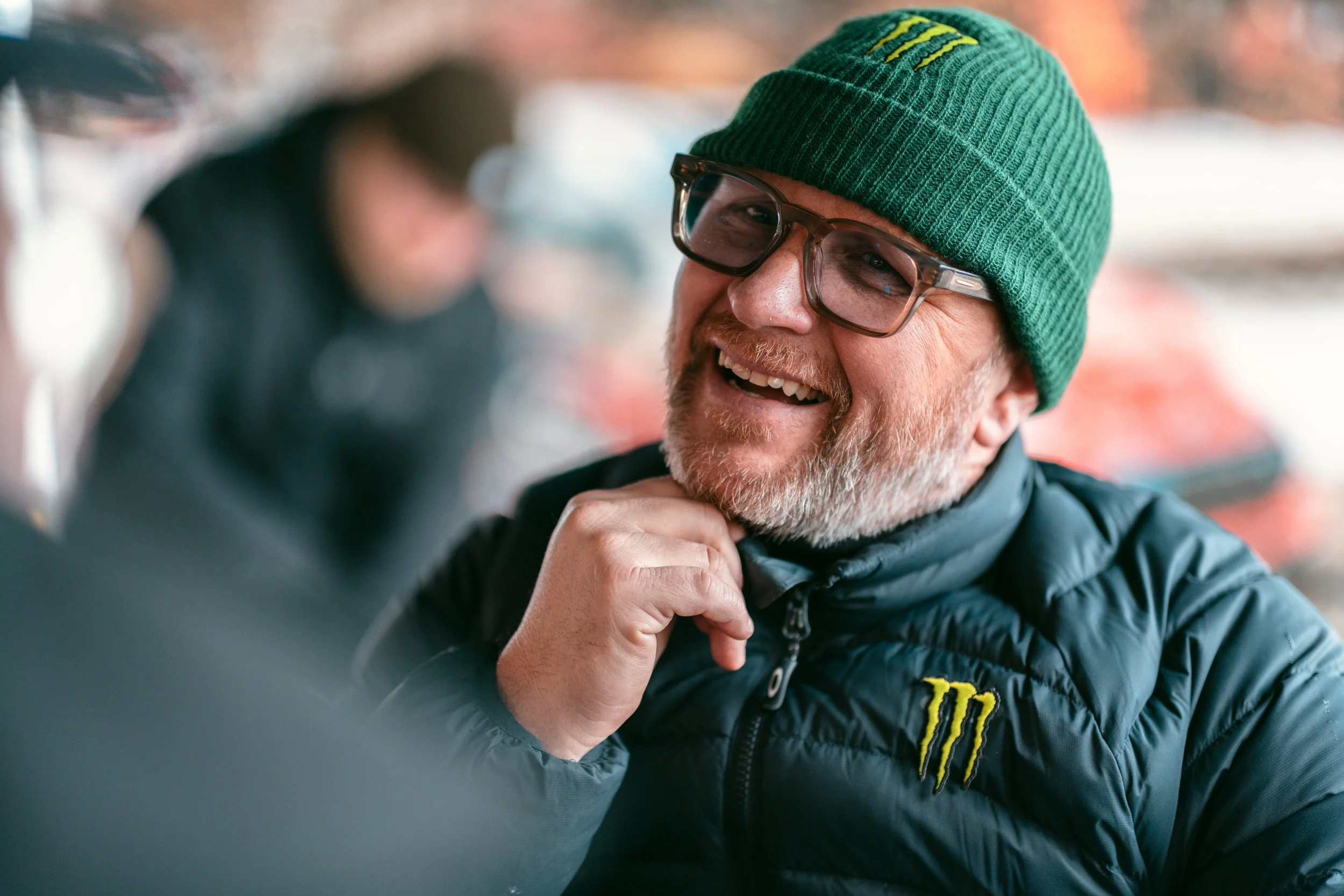
After lunch, I had some time to speak to Petter Solberg. There’s no hyperbole when it comes to say that he was my childhood hero, so this was a bit of a surreal feeling. But here’s the interview in full:
Lewis: I asked Oliver the same question, what makes a good co-driver and what did Phil [Mills] have that was so successful?
Petter: The relationship with your co-driver is so important and Phil and I had a great partnership over many years. I’m pretty certain he was the best-paid co-driver at the time, too! He was English, or should I say Welsh, so the flow and rhythm was much better than if I had a Norwegian co-driver.
L: You didn’t start out in rally, did you?
P: No, no, I started with RC cars. I was the youngest Norwegian champion in 1987. RC cars were very high-tech at the time. They had slip differentials, traction control, aerodynamics, and it all helped me learn and apply the skills to full-size cars.
L: Did winning with RC cars make you want to try rally?
P: No, not at all. For me, the dream was to be a mechanic, build cars, stuff like that. We come from a small country and when I was growing up, I did autocross because it’s what my parents did for 10 years, and they never had any decent results. My brother and I were building the cars and they offered for me to race one time. I got my licence and raced the weekend of my 18th birthday and finished second, in an old VW Beetle.
L: Does it help to have a good understanding of cars when being a rally driver?
P: It’s definitely one of the reasons why you succeed. It helps to have some technical background so you know what you need and what to ask for. All of this, plus the RC cars and mechanical understanding, helped a lot.
L: How long until people were noticing you were quite quick?
P: I did a show race in the European Championship in rallycross with my Volvo, and I killed everyone with my lap times, even with just rear wheel drive. This was the first time they started to take notice. And you could say the rest is history, ha! Then I was seven-time Norwegian champion in rallycross, won 19 out of 20 races in a year, so I wanted a new challenge. I had the chance to do the Renault Spider Cup, which was a support series to Formula One at the time, but I still wanted to try rally. A lot of people said it wouldn’t be possible, but I saw that as a challenge. So I went all in, borrowed money from the bank and took a massive risk to try rallying.
L: It has to work at that point, you’re under pressure to succeed. Would it have been back to being a mechanic if it failed?
P: Probably, but I never thought about that, didn’t have it in my mind.
L: One of my favourite stories about your career is the move from Subaru to Citroën in 2009. Can you tell me a bit more about that?
P: Ah, man, what a crazy story. The president of Subaru flew to Monaco to see me. I knew something was wrong straight away. I never thought I would get fired, ever. We had such a good relationship and we ended up crying in each other’s arms when he broke the news that Subaru were dropping out of WRC. The very same day, I called the people around me in Subaru to start a new team. Within three weeks, I’d built up a budget of €4-5 million, and Subaru helped to make it happen, which was fantastic. Huge respect to everyone at Subaru, they basically invested in my career to help make my own team with Citroën. It’s an unbelievable story. I’ve never heard of another story quite like it.
L: What was the process of getting cars from Citroën?
P: We had two or three Xsaras to start with. It was rare to get help from Citroën from outside of their factory team, as at the time they had Sébastien Loeb as their number one driver. So I made the car better myself. There was so much going on behind the scenes at that time.
L: One of the craziest stories of modern WRC for sure.
P: Yeah, I believed in myself so much, I knew I was very good, but I was unlucky in the Subaru situation with the timing in my career and the development of their cars.
L: Did Oliver surprise you when he won in Estonia?
P: Oh, I mean he’s very good. I know his driving and his mentality. He’s fucking mad. I came from a very normal background, but younger drivers have a lot to handle these days, with the fame and the money. When we moved to the farm, away from Monaco, people thought we were crazy. But to me, it was the main thing that made this possible for Oliver. If we stayed in Monaco, no chance. And the thing is, it has to come from your own passion and interest. Many people love to drive, but it’s a completely different lifestyle to compete and win.
L: Last thing I wanted to ask you was about PlayStation. I remember you having the PS2 logo on your car in the early 2000s, around the time of games like WRC 3 and Rally Evolved. Were you involved in the production of these?
P: I was involved in the first Colin McRae game. Colin and I developed that from hotel rooms around the world. We were staying together because we were teammates at the time. When he died in 2007, his wife wanted me to take over the game since I was involved from the start, but I had a contract with Microsoft in America that I couldn’t get out of. So that’s why its name changed to just DiRT, and people like Ken Block began to be involved with it too.
L: Those games are so important to me. Some very good memories from them.
P: Me too. I remember being in a hotel room and lying in bed with Colin and a computer, playing the game and writing down feedback.
L: Did games help you to practise or not?
P: No, not for me. I didn’t even watch onboard videos, just trusted the pace notes. Even driver aids like having numbers on the steering wheel, for Oliver and for me, there is nothing more important than just the feeling of the car. Trust your feeling, listen to the pace notes and the results will come. It’s especially important because you need to maintain energy for 14 rallies every single year, and the more scientific you get with improving, the more time-consuming it gets. It’s about managing your time too.
L: Final thing. “Mr. Hollywood”. Where did that come from?
P: Ha! I was actually very embarrassed about it when people first started shouting it, you know? It comes from when I did a lot of photoshoots, stunt driving and filming in Hollywood. Other drivers would tease me about it and tell me my driver overalls were too shiny and clean. And it just sort of stuck.
The next day (still no clean pants, by the way), we were invited to the Solberg family ranch for a Q&A and a traditional Swedish BBQ in a tent. Here, we chatted with other Monster athletes, like Luke Woodham and Baggsy. I was fed an elk burger (or maybe it was moose, no one seemed to know) and hung out with Oliver around the fire. You really can’t fault the lad. He’s all-in with rally. He’s said himself that it’s all he knows and that he never gets tired of racing or talking about racing or thinking about racing.
And speaking of racing, Petter’s museum showcased the family’s rich history and successes, from championship-winning cars to cabinet upon cabinet of trophies. A notable car was Petter’s WRC2002 Impreza, which he took to his first-ever WRC rally win. As part of his contract with Subaru, it had been agreed that Petter could take home his first rally-winning machine, so when the time came at Wales Rally GB in 2002, he had his car shipped to Sweden in the exact condition he left it in. Same seat, same tyres, same stickers. The car has lived in his museum, basically untouched, ever since.
“You only have one name, so it’s important to take care of it.”
This stand-out quote from Petter explains a lot about the longevity of the Solberg name. Oliver will have had a lot of pressure to match or surpass his father’s career results. He could have easily ridden on the back of this famous surname and coasted along, showing up and not troubling the top step of rallying, all while living the lifestyle of a global athlete. But Oliver is different. He has that motivation, that passion and the raw talent to make it all happen. He doesn’t take his privilege lightly and understands that the Solberg name is one to look after.
As Petter hands the torch to his son, he does so knowing it’s in good hands, and that Oliver is on the right trajectory to extend the lifespan of the Solberg name into the modern generation and beyond.
There’s a reason they’re the biggest motorsport family in the world, and there’s a reason you know the name Solberg.